

The tribunal on the crime of aggression against Ukraine marks "the point of no return" in the search for justice, the country's foreign minister said on Friday. But the court will face limitations in bringing Putin to justice.
Thirty-six countries, mainly from Europe, have signed up to a special tribunal to prosecute Russian President Vladimir Putin for the crime of aggression against Ukraine, which will be headquartered in the Dutch city of The Hague.
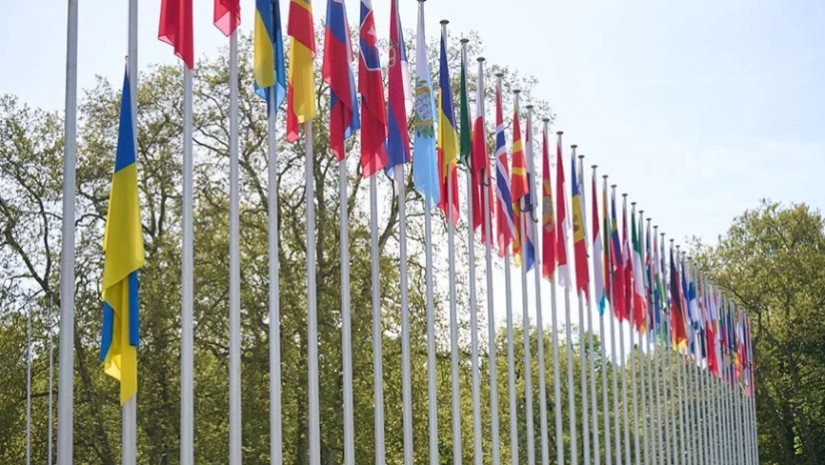
The joint pledge was formalised on Friday during the annual meeting of foreign affairs ministers of the Council of Europe, a human rights organisation that has taken the lead in addressing the jurisdictional gap left by the International Criminal Court (ICC).
Ministers endorsed a resolution laying down the structure and functions of the management committee that will oversee the tribunal. Among its tasks, the committee will approve the annual budget, adopt internal rules and elect judges and prosecutors. The countries commit to respecting the independence of the judicial proceedings.
Ukraine's foreign minister, Andrii Sybiha, who took part in the ceremony, hailed the moment as "the point of no return" in the years-long search for accountability.
"The Special Tribunal becomes a legal reality. Very few believed this day would come. But it did," Sybiha said on social media, evoking the spirit of the precedent-setting Nuremberg trials that brought to trial the surviving leaders of Nazi Germany.
"Putin always wanted to go down in history. And this tribunal will help him achieve this. He will go down in history. As a criminal," he added.
Friday's resolution was signed by Andorra, Austria, Belgium, Croatia, Cyprus, the Czech Republic, Denmark, Estonia, Finland, France, Germany, Greece, Iceland, Ireland, Italy, Latvia, Liechtenstein, Lithuania, Luxembourg, the Republic of Moldova, Monaco, Montenegro, the Netherlands, Norway, Poland, Portugal, Romania, San Marino, Slovenia, Spain, Sweden, Switzerland, Ukraine and the United Kingdom.
Australia and Costa Rica were the only non-European signatories.
The European Union also endorsed the initiative, even if four of its member states, Bulgaria, Hungary, Malta and Slovakia, did not add their names to Friday's resolution.
The list remains open for other countries, European and otherwise, to join.