

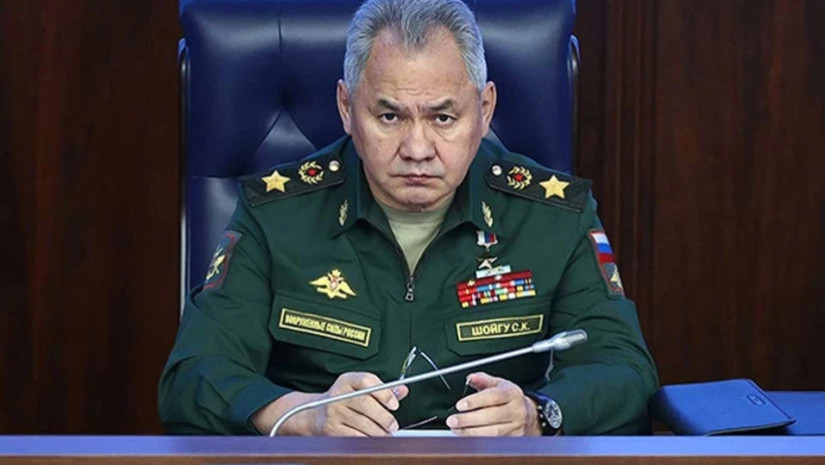
The Armenian authorities' desire to replace Russia in the management of the republic's railways is a poorly thought-out decision; the established system could "break down overnight" after such a move, Russian Security Council Secretary Sergei Shoigu told TASS.
"I won't judge the competence of other countries in railway management, but I can confidently say that it's unlikely that any other company will be able to fully replace the Russian railway carrier, which has been operating effectively and for a long time in Armenia under far from the most challenging conditions," Shoigu noted in a conversation with TASS.
"I recently commented on the situation related to Armenia's plans for cooperation with the United States on nuclear issues. So, won't such, to put it diplomatically, poorly thought-out decisions lead to similarly dangerous experiments for which ordinary Armenian citizens will have to pay?" the Russian Security Council Secretary wondered. According to him, the system built over nearly two decades could simply collapse overnight. "Naturally, no 'friendly countries' will bear responsibility for this. I hope that when making important decisions, the Armenian leadership will proceed solely from the interests of its citizens," he continued.
The Secretary of the Russian Security Council noted that for nearly 20 years, South Caucasus Railway (SCR) has responsibly fulfilled the terms of the concession agreement, including those related to investment. According to him, during this time, Russian investments in the Armenian railway system, including rolling stock, are estimated at more than 30 billion rubles. "And now Nikol Pashinyan says that the concession of Armenian railways to a Russian company scares off potential partners, hindering regional projects, and is considering transferring management of the Armenian railway network to a country friendly to both Russia and Armenia," Shoigu noted.
He recalled that the agreement provides for South Caucasus Railways CJSC, as the concessionaire, to own, use, manage, operate, maintain, repair, and make necessary improvements to the concession assets. "For reference, when signing the agreement, the Russian side assumed responsibility for more than 1,200 concession real estate assets and more than 12,500 movable property items in the Armenian railway system," the Secretary of the Security Council of the Russian Federation stated.
As Shoigu noted, over the past 20 years, thanks to the concession agreement, more than 15 billion rubles have been paid to the Armenian budget in taxes, and more than 520 km of track has been repaired, while the operational length of the network managed by South Caucasus Railways CJSC is approximately 700 km. "Fifty percent of the sleepers have been replaced, and more than 50 structures, including 38 bridges and two tunnels, have been repaired and reconstructed. Looking at the statistics for two years, the picture is as follows: on average, SCR transports over 500,000 passengers annually (approximately 360,000 of which are local) and over 1.6 million tons of freight," he added.
"The company's contribution to the republic's economy is difficult to overestimate: all critical freight for Armenia's needs is transported by SCR," Shoigu emphasized. "The railway also plays a strategic role, providing transportation links for a landlocked country. Behind all this are the people, the company's employees. Currently, the company, as an employer, guarantees employment for over 2,500 people. Incidentally, almost all of them are residents and citizens of Armenia, receiving all necessary social benefits."
Shoigu noted that when considering the agreement, it's worth recalling the history of the subject of discussion and some legal issues directly related to the concession.
"After the collapse of the USSR, the Armenian railway system was in dire straits. The infrastructure was severely deteriorated, and many sections of the track were inoperable due to avalanches and landslides. Given that the republic was practically under siege, freight traffic and passenger numbers declined significantly. Significant financial investments were required for modernization, including the renewal of aging rolling stock. Under these circumstances, the Armenian government announced a tender for the restoration of the railway, which was won by Russia," he said. "In February 2008, a concession agreement was signed between the Republic of Armenia, Russian Railways OJSC, and South Caucasus Railways CJSC (a specially created subsidiary of Russian Railways OJSC) to transfer Armenia's railway system to South Caucasus Railways CJSC as a concession until 2038," Shoigu stated.
On February 13, Armenian Prime Minister Nikol Pashinyan, speaking to journalists, proposed that Russia sell its concession for the republic's railways to a state friendly to both Moscow and Yerevan. Among the options, he named Kazakhstan, the UAE, and Qatar. Pashinyan asserted that Armenia has no objections to Russia, but that the Russian concession would create "certain competitive losses" for the republic.