

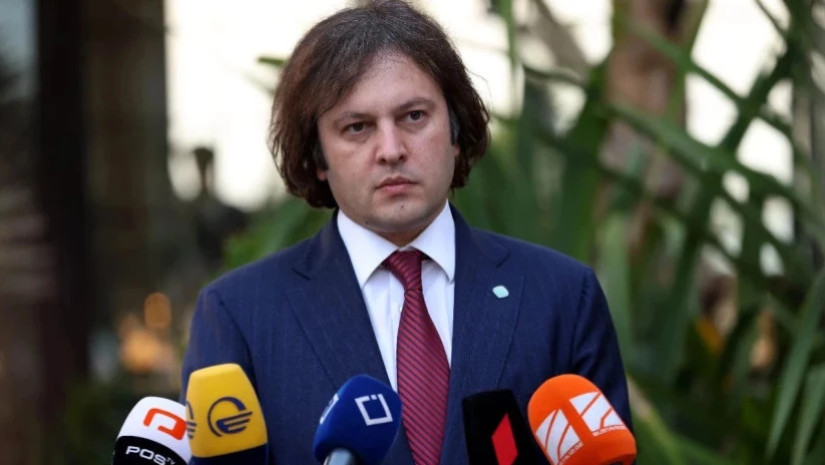
The Middle Corridor, which connects East Asia to Europe via Central Asia, the Caucasus, and Turkey, offers something increasingly rare in today’s world: a stable, reliable transit route that overcomes geopolitical divides, Georgian Prime Minister Irakli Kobakhidze said in his speech at the 2026 World Government Summit.
According to the head of government, in a world where traditional routes are not reliable, alternative corridors are becoming necessary.
“The question before us today is not about transformation, as is becoming clear, but the real question is how we respond to it; how to create a trading system that is resilient enough to withstand geopolitical shocks and open enough to ensure prosperity.
In a world where traditional routes are unreliable, alternative corridors are essential. In a fragmented global economy, countries that can bridge the gaps are invaluable, and in an era of uncertainty, stability itself is a strategic asset.
The world needs more sustainable trade, not less. It doesn’t need isolation, it needs intelligent diversification. It doesn’t need to choose sides – it needs reliable connecting bridges.
This leads us to a middle corridor that is no longer just an option, it is now an inevitability of global trade. The Middle Corridor, which connects East Asia to Europe through Central Asia, the Caucasus, and Turkey, offers something increasingly rare in today's world: a stable, reliable transit route that overcomes geopolitical divisions," the Prime Minister said.
He also said that today, the world's commercial routes are being changed not by the invisible hand of the market economy, but by the very clear fist of geopolitics.
“Consider what has happened to global trade in the past few years. Northern corridors, once efficient at moving goods between Europe and Asia, have been severely disrupted by the war in Ukraine; supply chains that took decades to build have collapsed overnight; businesses that had planned to increase efficiency have suddenly found themselves in a fight for survival.
Looking east, we see that Pacific trade routes have become increasingly politicized by great power tensions. Tariffs, sanctions, and strategic divisions have turned what was once the world’s most dynamic commercial relationship into a complex geopolitical confrontation. Even the most traditional partnerships are facing unprecedented friction. Trade disputes and political disagreements have added uncertainty to once-stable relationships. This is not the economic globalization we once understood. We are now entering the first phase, where geography still matters, where stability becomes a competitive advantage, and where the ability to maintain relationships is not a diplomatic charm, but an economic necessity," the Prime Minister noted.