


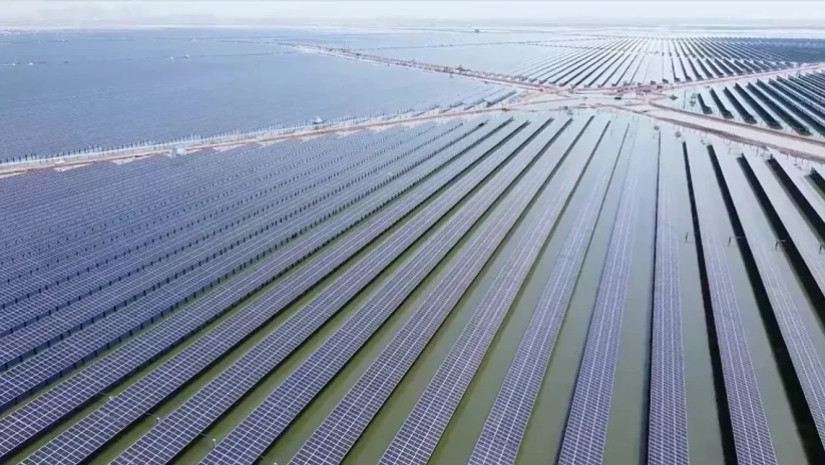
China has achieved a remarkable milestone in renewable energy with the completion of the first phase of the world’s largest hydro-solar power plant. This groundbreaking project, named Kela, combines hydroelectric and photovoltaic technologies, making it a unique and innovative venture. With its impressive installed capacity and ability to generate clean energy, the Kela power plant is set to revolutionize the renewable energy landscape. Let’s delve into the details of this monumental project that officially commenced operations on June 25, 2023.
The Kela power plant, situated in southwest China’s Sichuan Province, marks a significant milestone in the pursuit of sustainable and clean energy sources. With a total installed capacity exceeding 1 million kilowatts, Kela boasts the world’s highest power station of its kind. This immense capacity positions it as a key player in China’s ambitious plan to enhance energy security and achieve its dual carbon goals.
The first phase of Kela includes 1 GW of solar power capacity and 3 GW of hydropower generation. The Lianghekou station, which will be fully operational this year, is a 3-GW hydroelectric facility featuring six 500-MW Francis turbines. Kela harnesses the power of both hydroelectricity and photovoltaic energy generation methods. By utilizing a water-light complementary approach, this power plant ensures a stable and uninterrupted supply of electricity.
The scale of the Kela power plant is truly awe-inspiring. Spanning an area exceeding 16 million square meters, equivalent to more than 2,000 standard football fields, it is a testament to human engineering prowess. Located at an altitude of approximately 4,600 meters, the power plant stands alongside China’s National Highway 318, a crucial transport route connecting Sichuan and the neighboring Xizang Autonomous Region.
The construction of Kela required the installation of a staggering 527,000 photovoltaic foundation piles, weighing the equivalent of 222 C919 aircraft, China’s domestically constructed large passenger plane. The length of these interconnected piles surpasses 1,400 kilometers, which is eleven times the length of the Beijing-Tianjin Railway. Additionally, over 2 million photovoltaic modules were assembled, covering an area equivalent to three Beijing Daxing International Airports.
The Kela power plant is a monumental step towards reducing carbon emissions and combating climate change. With an annual generating capacity of 2 billion kilowatt-hours (kWh), it will provide sustainable electricity to approximately 700,000 households for an entire year. The clean energy generated by Kela will offset carbon dioxide emissions by more than 1.6 million tonnes, equivalent to the reduction achieved by avoiding the burning of 600,000 tonnes of standard coal. Such significant environmental benefits will contribute to China’s commitment to achieving peak carbon emissions and carbon neutrality.