


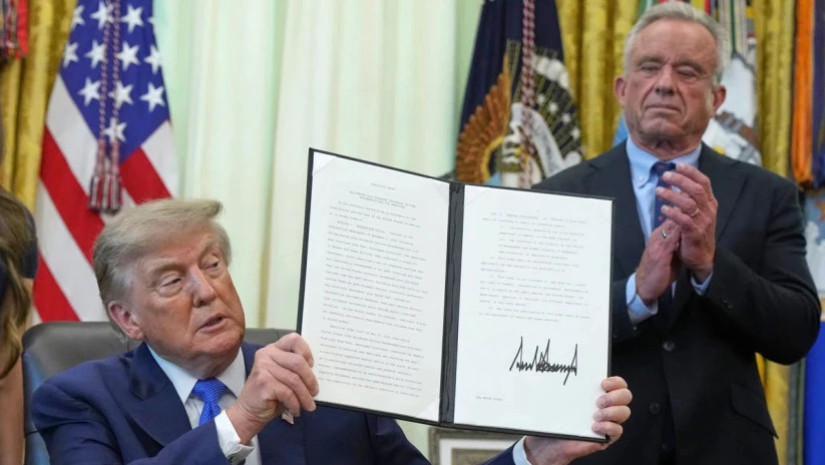
Donald Trump has signed an executive order with plans for sweeping changes to the childhood vaccination schedule that attempts to override the authority of the US Centers for Disease Control and Prevention (CDC).
It is an attempt to undergird the changes made earlier this year to CDC vaccination recommendations, which were halted by a federal judge. The CDC is the federal agency tasked with recommending vaccines, not the White House.
The order would also require that the measles, mumps and rubella vaccine be broken into three separate shots, once it becomes available in the US. And it would recommend that all shots be given at separate medical visits, a frequent point Trump has made despite the safety, ease and lower costs of giving vaccines together.
On a press call, a White House official said the order draws on a Department of Health and Human Services (HHS) scientific assessment published in January 2026, which examined “comparisons of the US to other peer-developed nations” and looked at “where there is consensus amongst our peers on recommendations for immunizations for children”.
The official said the number of recommended childhood immunizations would drop “down to 11 diseases”, compared with 18 at the end of 2024.
Only six of the 17 vaccines currently routinely recommended for all children in the US would continue to have full recommendations: measles, mumps, rubella (MMR), diphtheria, tetanus, pertussis (DTaP), polio, Hib, pneumococcal disease, HPV and varicella.
“Together, there could be a possibility they’re quite lethal,” Trump said of the MMR vaccine at the signing of the order on Monday.
Five other shots would be recommended only for those at high risk: monoclonal antibodies to protect against respiratory syncytial virus (RSV) as well as vaccines against hepatitis A, hepatitis B and meningococcal ACWY, which is recommended for teens and high-risk infants. Dengue and meningococcal B vaccines are also on this list, but dengue was already recommended only for those at risk and meningococcal B was shared clinical decision-making.
And six shots would be pushed to shared clinical decision-making: hepatitis A, hepatitis B, rotavirus, meningococcal disease, influenza and Covid-19.
This is a previously obscure category that means a provider would be required to weigh the risks and benefits, despite strong evidence for the safety and efficacy of these vaccines.