

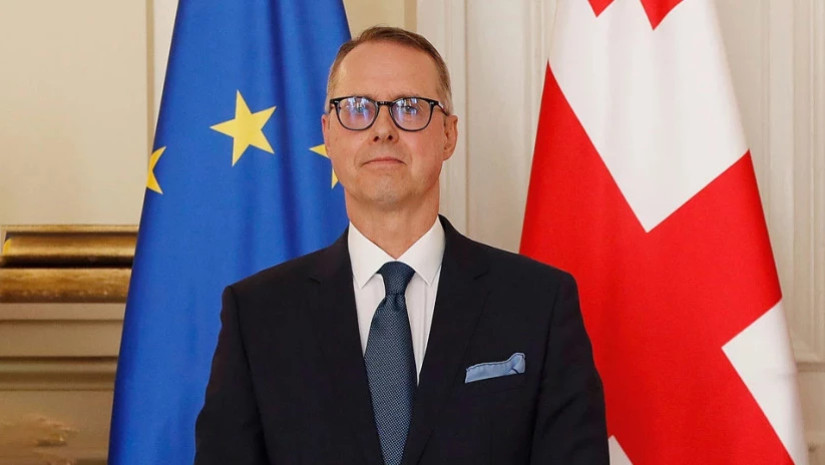
Germany's Ambassador to Georgia, Peter Fischer, confirmed that a legislative proposal regarding the sanctioning of Kulevi was presented in the EU's 20th sanctions package.
As the ambassador explained during a panel discussion at an event dedicated to the fourth anniversary of Russia's full-scale invasion of Ukraine, the legislative proposal for sanctioning was accompanied by a package of evidence. According to Peter Fischer, yesterday the European Union failed to adopt the 20th sanctions package due to vetoes from Hungary and Slovakia.
“Yesterday in the European Union, we were supposed to adopt the 20th sanctions package, which was quite extensive and included new measures against Russian oil, against ports that receive Russian oil, and also against ports that receive tankers from Russia's 'shadow fleet.' We did not adopt this package because Hungary and Slovakia imposed a veto.
Regarding Georgia, I want to note that Hungary is your best friend in the European Union, which the Georgian authorities have chosen as their ally, which, as they say, should help you with accession to the European Union - think again, this will not happen!
We talked about sanctions, and I want to tell you that the sanctions package included the Kulevi port. This was a legislative proposal in the European Union. It was also blocked by these two countries [Hungary and Slovakia]. When there is a legislative proposal in the European Union regarding the imposition of sanctions, it is accompanied by a package of evidence; we simply do not say: you know, something might be happening in Kulevi, so let's sanction it. No, we present a package of evidence, and as I already said, there was both the legislative proposal and the package of evidence.” - stated the ambassador.