

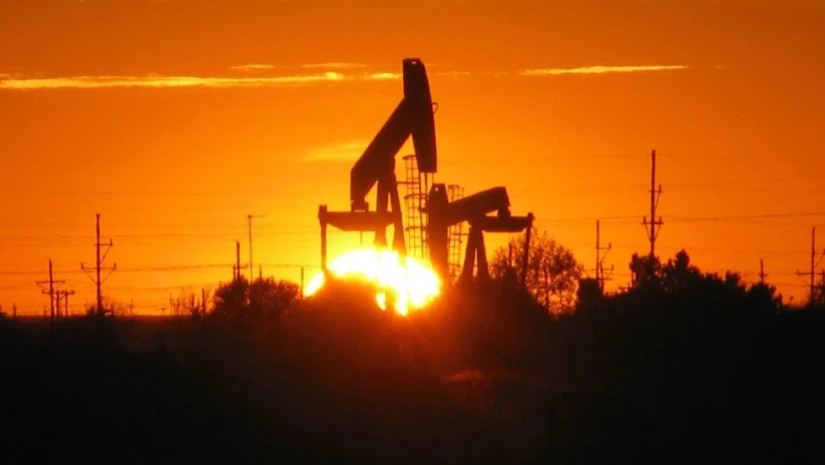
Brent crude futures breached the $100-a-barrel mark Wednesday for the first time since July, gaining over 2% amid a sharp escalation in U.S.-Iran hostilities. European natural gas prices moved sharply higher as well, advancing close to 4% and approaching 79 euros per megawatt-hour, a level that would mark the highest settlement since late 2022.
Four Iranian tankers were sunk by the U.S. in the Gulf of Oman, with a fifth destroyed near Kharg Island on Tuesday, after Tehran attempted to strike American warships, according to The Wall Street Journal. Brent crude's previous visit to $100 came in July, after which prices retreated beneath $80 in early August — meaning Wednesday's surge represents a roughly $20 rebound within just a matter of weeks.
U.S. stock futures fell in early Wednesday trading. Dow Jones Industrial Average futures dropped 331 points, or 0.6%, while S&P 500 futures shed 0.4% and Nasdaq-100 futures fell 0.5%.
The moves follow a losing session on Tuesday — the first trading day of a holiday-shortened week after the Labor Day holiday on Monday. Tuesday's session left the Dow 1.2% in the red, a decline that stood as its steepest in close to three weeks. The S&P 500 gave back 0.6% and the Nasdaq Composite shed 0.3%.
The 10-year Treasury yield touched above 4.8% on Tuesday, with the climb in oil prices feeding broader inflation worries and dragging on equities throughout the day. Yields edged higher again Wednesday as traders awaited details from the Treasury Department on the size of a buyback operation for longer-term bonds planned for Thursday, according to The Wall Street Journal.
European stocks were also lower. The Stoxx 600 fell 0.69%, Germany's DAX slid 0.68%, France's CAC 40 dipped 0.95%, and Italy's FTSE MIB shed 1.27%. The U.K.'s FTSE 100 was down 0.32%.
Asian markets were mixed. Japan's Nikkei 225 closed 0.19% lower and Australia's S&P/ASX 200 fell 0.11%, while South Korea's Kospi rose 1.40% and mainland China's CSI 300 gained 0.30%.
Wednesday's calendar is empty of significant economic reports and earnings announcements. Upcoming inflation data later in the week are likely to shape expectations around the Federal Reserve's next policy move.
Kara Murphy, chief investment officer at Kestra Investment Management, told CNBC's "Closing Bell" that the market's center of gravity has shifted: "There's a little bit less to focus on with the earnings front, so I think the market has sort of shifted its attention now to the risk side."